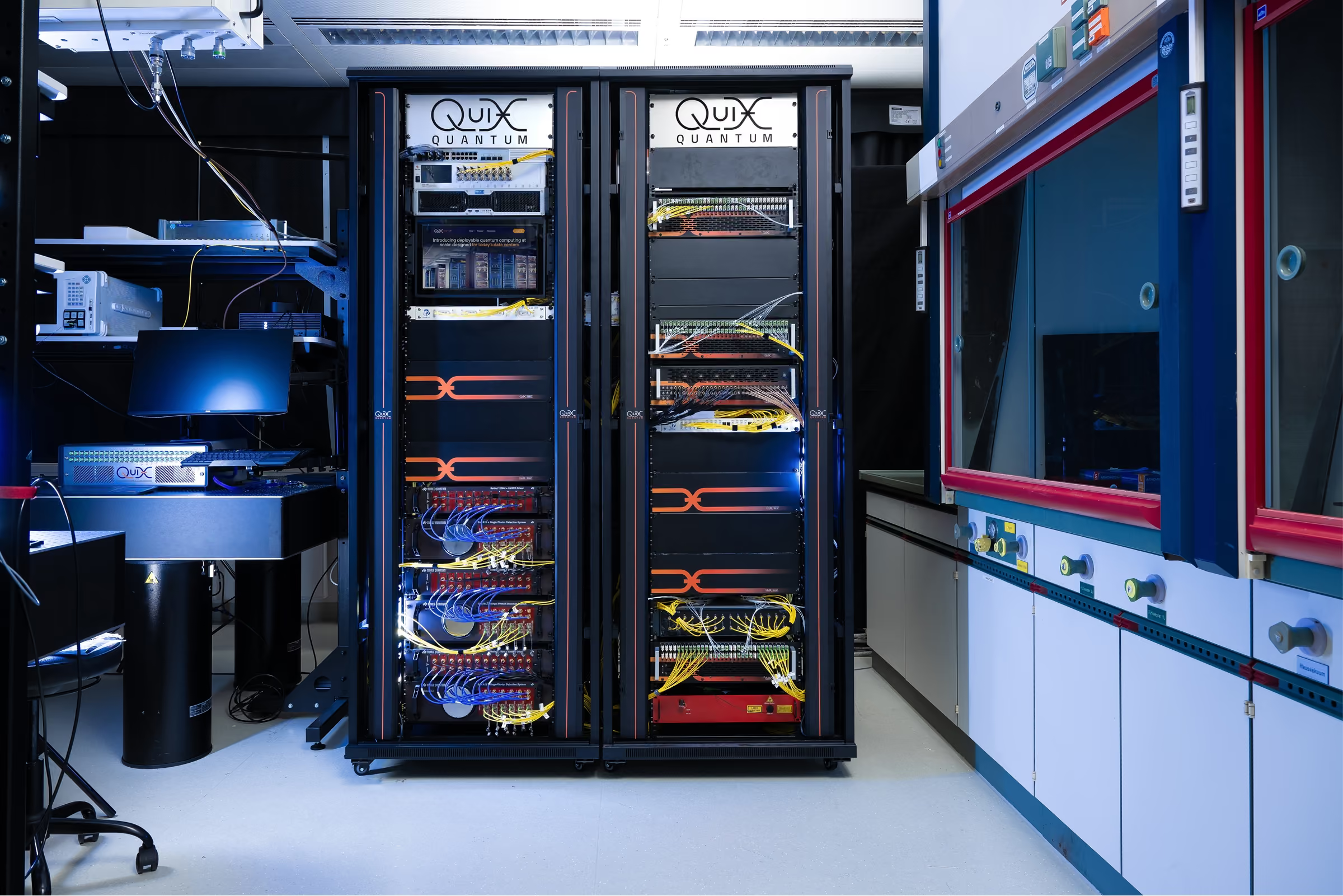
QuiX Quantum Launches Alquor 2.0 to Accelerate Photonic Quantum Research Beyond the Optical Table
System provides universities and research organizations a programmable, rack-mountable quantum photonic processor


Enschede, The Netherlands - August 4, 2026 – QuiX Quantum today announced the commercial availability of Alquor 2.0, the next generation of its rack-mountable quantum photonic processor platform, available in 8-mode, 20-mode and 32-mode configurations, for advanced quantum optics, quantum communication, boson sampling, quantum information processing, and photonic quantum computing research. Alquor 2.0 is designed to reduce lab complexity and accelerate experimental progress.
Built on QuiX Quantum’s proven silicon nitride photonic technology and integrated into the company’s new Photonic Assembly Control Unit (PACU) architecture, Alquor 2.0 is designed to help research teams move from complex, manually aligned optical table configurations to a stable, programmable, and scalable integrated photonic platform. The technology behind Alquor 2.0 has been validated in several papers, from QuiX as well as from third parties.
With more than 20 systems deployed to date, Alquor has become one of the most established commercial programmable photonic processing platforms in quantum optics research. The new Alquor 2.0 extends this foundation with enhanced scalability, improved control electronics, stronger thermal stability, and configurations for 8-mode, 20-mode, and 32-mode research environments.
“Photonic quantum research should not be limited by the complexity of repeatedly configuring, aligning, and stabilizing optical table setups,” said Caterina Taballione, Commercial & Partnership Lead at QuiX Quantum. “Alquor 2.0 gives researchers a programmable and reproducible platform, so they can spend less time managing experimental infrastructure and more time advancing quantum science.”
For research teams, Alquor 2.0 is designed to reduce the operational burden of traditional optical table experiments. Instead of spending significant time on manual alignment, stabilization, and repeated configuration work, researchers can use a fully programmable processor that supports reproducible experiments and faster iteration cycles.
Alquor 2.0 is built on QuiX Quantum’s silicon nitride plat form, enabling ultra-low optical loss, room-temperature operation, and high fidelity. The new generation introduces current-driver-based control to reduce electrical crosstalk, improved thermal management through air cooling, and a cleaner software and firmware stack designed to improve performance and reproducibility.
The system is designed for modern laboratory, rack-mounted, and HPC-oriented environments. Its 3U 19-inch ruggedized form factor, Ethernet connectivity, and Python interface allow researchers to integrate Alquor 2.0 into existing automated workflows and scalable research infrastructure.
Key features of Alquor 2.0 include:
- Available with 8-mode, 20-mode or 32-mode quantum photonic processors
- Fully programmable multimode linear optical interferometer
- Room-temperature operation based on silicon nitride photonic integration
- Integrated into QuiX Quantum’s PACU architecture
- Architecture capable of supporting up to 32 operational modes
- Future-proof control design capable of managing up to 1,000 thermo-optic modulators
- Current-driver architecture to reduce electrical crosstalk between phase shifters
- 32 high-speed RF connectors for external control systems and future fast-feed-forward capabilities
- Air-cooled thermal management for higher operational reliability
- Hot-swappable photonic assemblies with local calibration and characterization data
- Python interface for integration into automated lab workflows
- 3U 19-inch rack-mountable chassis for laboratory, datacenter, and HPC-oriented environments
Alquor 2.0 supports a broad range of quantum photonic use cases, including quantum optics research, boson sampling, quantum random walks, quantum communication, quantum sensing, optical switching, and the development of photonic quantum computing architectures.
Validated Across the Global Research Community
Alquor's impact extends well beyond QuiX Quantum's own labs: independent research groups worldwide have used Alquor-based processors to produce some of the most closely watched results in photonic quantum information science. Recent examples include:
- Simulating open and dissipative quantum systems — implemented leaking quantum walks with controllable absorbing boundaries on a 20-mode Alquor processor, a new approach to modeling non-Hermitian quantum dynamics on chip. ENEA, INFN Roma Tre (2026) arXiv:2601.13269. View paper
- Simulating molecular chemistry with photonics — reconstructed molecular vibronic spectra using a Alquor processor under a linear-coupling approximation, connecting Gaussian boson sampling to real chemical systems. Paderborn University and HQS Quantum Simulations (2026) arXiv:2507.19442. View paper
- Benchmarking sampling algorithms on a single platform — integrated a 12-mode Alquor processor into the Paderborn Quantum Sampler to directly compare Gaussian and non-Gaussian boson sampling in the same experimental run. Fraunhofer IOF, Menlo Systems and Paderborn University (2026) arXiv:2512.08433v1. View paper
- Improving photon-source reliability for fault-tolerant photonic quantum computing — demonstrated photon distillation on a 20-mode Alquor processor, achieving below-threshold and net-gain reduction of photon-indistinguishability errors. Freie Universität Berlin, NASA Ames, University of Twente (2026) arXiv: 2601.05947. View paper
- Accelerating Monte Carlo computational workloads — used a programmable 12-mode Alquor processor to demonstrate boson sampling as a hardware accelerator for Monte Carlo integration. University of Twente (2025) arXiv: 2509.25404. View paper
- Running quantum search algorithms — implemented deterministic Grover search on 20- and 12-mode Alquor processors, achieving 99.77% average success probability. University of Queensland, University of Western Australia and Pawsey Supercomputing Centre (2025) arXiv: 2506.06435. View paper
Early Adopter Program for Research and Universities
To support early access for academic and public research institutions, QuiX Quantum is offering a 20% early adopter discount for eligible universities and research organizations ordering Alquor 2.0 8 mode by September 30, 2026.
The early adopter program is designed to help research teams accelerate access to integrated photonic quantum processing and reduce the transition effort from complex bulk-optics setups to programmable photonic systems.
Availability and Pricing
Alquor 2.0 is available now in three configurations:
- Alquor 2.0 — 8-mode processor: 240.000 EUR*
- Alquor 2.0 – 20-mode processor: 490.000 EUR
- Alquor 2.0 — 32-mode processor: 790.000 EUR
Final pricing depends on configuration, delivery scope, service options, and customer-specific requirements. Customers, research institutions, and partners can contact QuiX Quantum for configuration options, delivery timelines, and a tailored quote. All prices are excl. VAT.
*Early Adopter Program applicable by ordering by September 30, 2026.
For quotes and commercial inquiries, please contact:
sales@quixquantum.com
+31 (0)53 48 36 444
www.quixquantum.com
About QuiX Quantum
QuiX Quantum is a European photonic quantum computing company founded in Enschede, the Netherlands, in 2019. The company develops integrated photonic quantum computing hardware and describes its approach as full-stack and fabless, with systems designed for modularity, scalability, and compatibility with data center and HPC environments. QuiX Quantum has offices in the Netherlands and Germany and is developing universal photonic quantum computing systems based on its silicon nitride photonic technology.